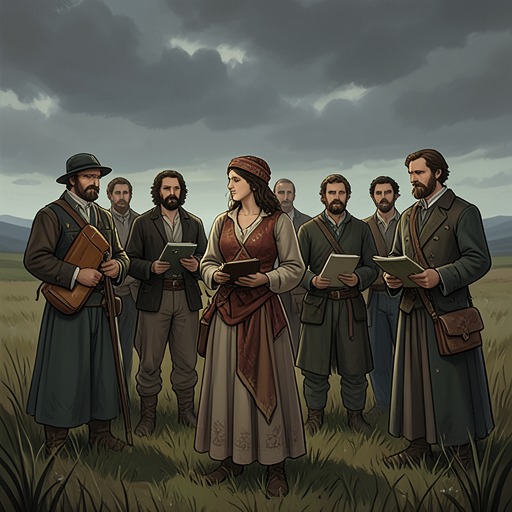
Our songs travel the earth.
The Master Butchers Singing Club“Our songs travel the earth.” is a recurring expression of the novel’s vision of music as a common inheritance: songs move among people and across the landscape, connect the living with the dead, and outlast any single singer. Its force lies in refusing the idea that a song belongs only to its performer. Each voice joins a much older circulation of sound, memory, and shared life.
The Song as a Shared Inheritance
The expression appears amid a panorama of singing that reaches across cultural and communal boundaries. The voices include foolish ballads, strict anthems, German sailor’s songs, voyageurs’ paddling songs, patriotic American songs, Cree lullabies, sweat lodge summons, lost ghost dance songs, counting rhymes, and hymns to the snow. The variety does not dissolve into sameness: each kind of song retains its character, yet all participate in the same movement of singing to one another.
The passage makes that movement explicit by insisting that no note is ever lost and no song is original. Songs come from the same place and return to a time when only the stones howled. The expression therefore presents music not as a sequence of isolated compositions but as an inheritance continually received and passed on. A singer adds a voice to a tradition that precedes that singer and will continue beyond it.
Voices Moving Through Argus
The phrase is embedded in a vivid description of sound traveling through Argus. The air scours the fields, strikes telephone wires and trees, and is funneled through streets and around buildings. Singing flows over rooftops, enters chimneys, catches in alleys, and bends tree branches into a muted, off-key roar. This physical route gives the expression a literal as well as figurative reach: songs cross distances, pass through ordinary structures, and become part of the town’s shared atmosphere.
The movement gathers sharply different voices into one acoustic landscape. At one moment the singing is joyful and blustering; elsewhere it is mournful or devotional. The passage does not claim that every song says the same thing. Instead, their coexistence makes the town sound like a meeting place for distinct histories and forms of belonging.
The Living and the Dead
The expression also resonates with the passage’s account of Step-and-a-Half and the ghost shirt. She has kept a scrap of the shirt, touching its faded crow and pressing her cheek to the painted moon. She rejects the idea that the ghost dancers were foolish or deluded: they understood that the dead remained close, one song away from the living. The shirt’s cloth allowed its wearer to visit the dead and draw comfort from their singing.
That belief deepens the meaning of songs traveling the earth. Their journey is not only from one living singer to another; song also crosses the boundary between the living and the dead. Step-and-a-Half’s scrap of cloth, the remembered songs, and the voices she hears in Argus all participate in a world where music carries presence across absence. As she hums in her sleep, her own tune is a gathered, untidy store of courting verse, hunters’ wisdom, itinerants’ sayings, and words borrowed from grass, cloud, and a prophetic pig’s knuckle. The expression thus names a circulation broad enough to include remembered voices, fragments, and lives that cannot be reduced to a single origin.